1+2[1] 3You will find basic R codes
1+2[1] 3# Load necessary library
library(deSolve)Warning: package 'deSolve' was built under R version 4.3.3# Define a simple Lotka-Volterra predator-prey model
lotka_volterra <- function(t, state, parameters) {
with(as.list(c(state, parameters)), {
dPrey <- prey * (alpha - beta * predator)
dPredator <- predator * (delta * prey - gamma)
list(c(dPrey, dPredator))
})
}
# Initial state values
state <- c(prey = 40, predator = 9)
# Parameters: growth rate of prey, predation rate, reproduction rate of predator, and death rate of predator
parameters <- c(alpha = 0.1, beta = 0.02, delta = 0.01, gamma = 0.1)
# Time sequence for the simulation
time <- seq(0, 200, by = 1)
# Solve the differential equations
output <- ode(y = state, times = time, func = lotka_volterra, parms = parameters)
# Convert output to a data frame
output <- as.data.frame(output)
# Plot the results
plot(output$time, output$prey, type = "l", col = "blue", xlab = "Time", ylab = "Population", main = "Lotka-Volterra Predator-Prey Model")
lines(output$time, output$predator, col = "red")
legend("topright", legend = c("Prey", "Predator"), col = c("blue", "red"), lty = 1)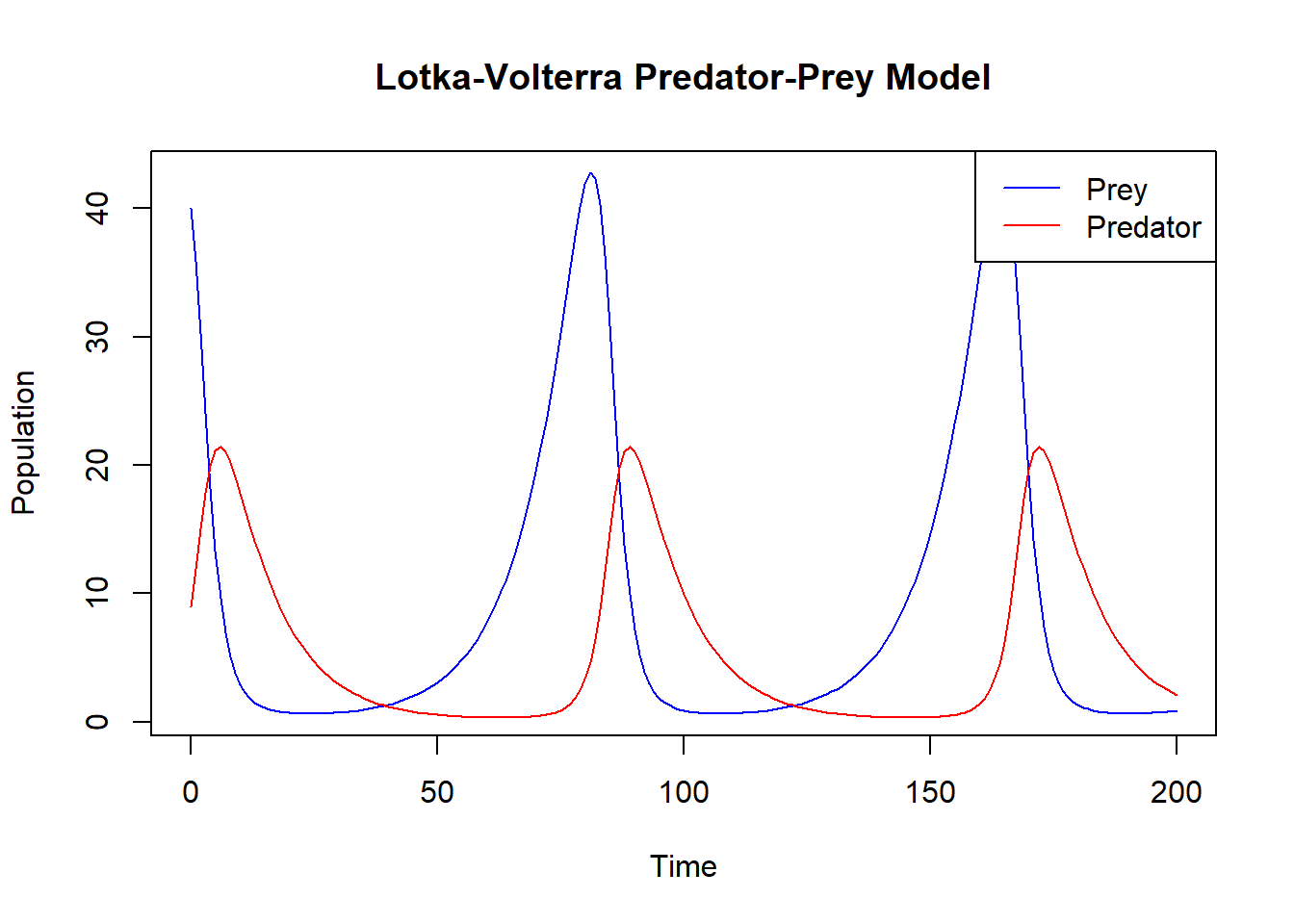
# Load necessary library
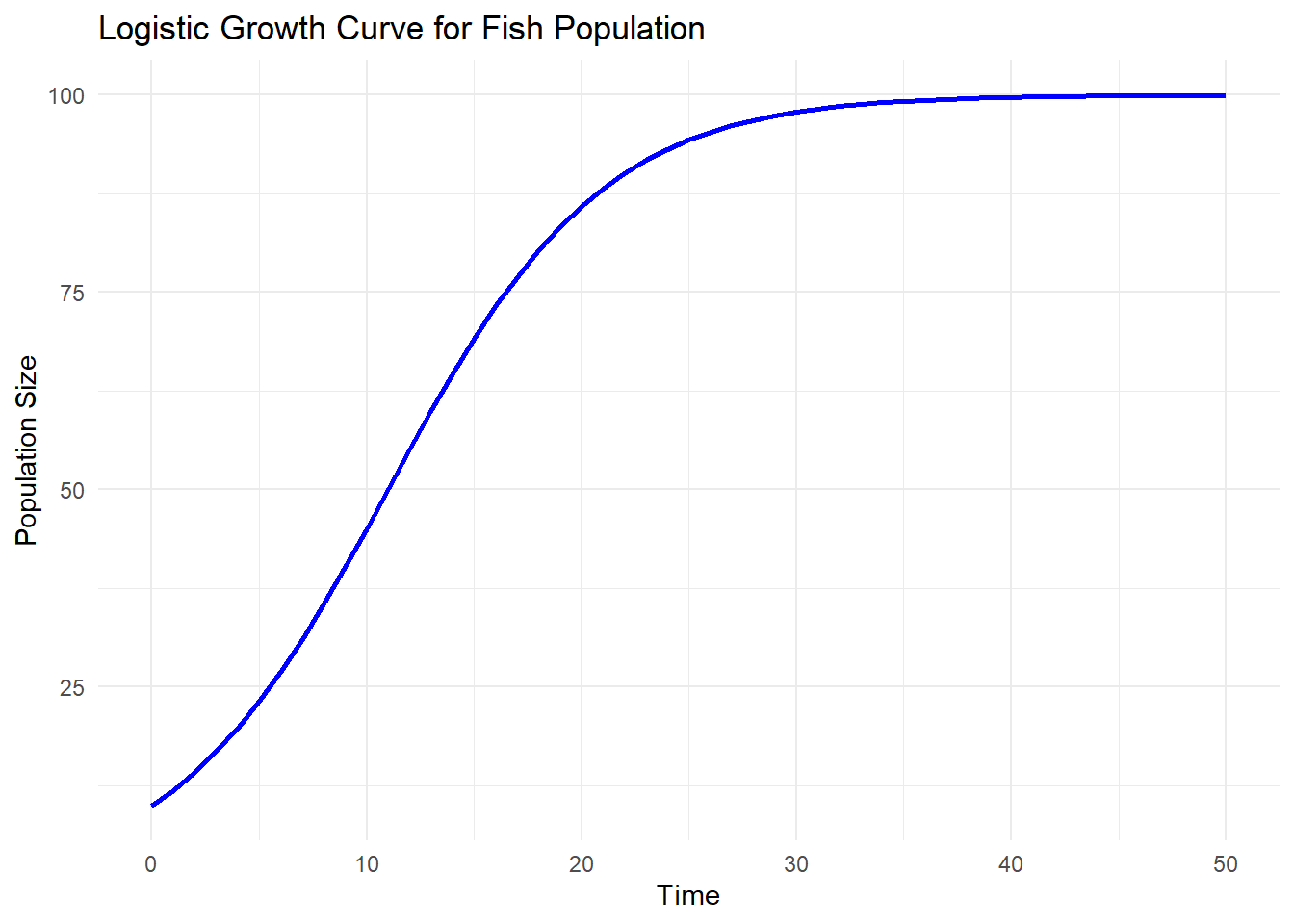
library(ggplot2)
Warning: package 'ggplot2' was built under R version 4.3.3# Define the logistic growth function
logistic_growth <- function(t, K, r, N0) {
K / (1 + ((K - N0) / N0) * exp(-r * t))
}
# Parameters for the logistic growth curve
K <- 100 # Carrying capacity
r <- 0.2 # Growth rate
N0 <- 10 # Initial population size
time <- seq(0, 50, by = 1) # Time sequence
# Calculate population size over time
population <- logistic_growth(time, K, r, N0)
# Create a data frame for plotting
data <- data.frame(Time = time, Population = population)
# Plot the logistic growth curve
ggplot(data, aes(x = Time, y = Population)) +
geom_line(color = "blue", size = 1) +
labs(title = "Logistic Growth Curve for Fish Population",
x = "Time",
y = "Population Size") +
theme_minimal()Warning: Using `size` aesthetic for lines was deprecated in ggplot2 3.4.0.
ℹ Please use `linewidth` instead.